


The Grief of Losing a Dog.
The Grief of Losing a Dog: When Love Has No Species
At Chasing Perfection Dog Training, dogs are not “just pets.”They are family. They are our constants, confidants, routines, purpose, and sometimes the reason we get out of bed in the morning.
Losing a dog is a type of grief that is still widely misunderstood and often minimised. Yet for those who have lived it, the pain can be overwhelming, consuming, and life-altering — not only for us, but for the other animals who shared their lives.
I have now lost three dogs in my lifetime;Kelly, Chase, Zoe. Three dogs, three very different losses, three very different forms of grief.
The Many Faces of Grief
Grief does not look the same every time.
Sometimes it comes after a long goodbye, where you have time to prepare, to cherish, to say “thank you” again and again. Sometimes it arrives like a freight train, sudden and traumatic, stealing the breath from your lungs and leaving you shattered in its wake. And sometimes, grief begins before the loss itself — what is known as anticipatory grief.
All forms are valid, all forms are real.

Kelly: The Slow Goodbye and the Weight of Guilt
Kelly was our family dog. She lived to the beautiful age of 14.5 years and, like many senior dogs, had begun to slow down. She showed signs consistent with Canine Cognitive Dysfunction (often described as dog dementia): confusion, changes in routine, moments where she seemed lost in her own home.
I was on University holidays from Queensland at the time and was incredibly grateful to spend her final weeks with her. Chase and I drove down to Terrigal on the NSW Central Coast, and we soaked up every moment.
The day before we said goodbye, Kelly had the best day she’d had in months. She walked further than she had in a long time. She played ball. She played with her favourite bucket. She even played a little with Chase.
The next morning, she couldn’t get up. She didn’t want her breakfast — except for roast beef. She still had fight in her, right to the very end, even giving the vet a run for their money.
I held her in my arms, sobbing, as we let her go. We brought her home and laid her to rest in her favourite spot in the yard.
When we returned home, Chase ran straight to her. He sniffed her, paused… and then began to cry and howl.
That sound broke my heart more than anything else.
It was the first time I had ever truly seen an animal mourn.
With Kelly’s loss came immense guilt .Did we do the right thing? Was she just having a bad day? Had she been suffering longer than we realised?
Guilt is one of the heaviest companions of grief, especially when euthanasia is involved — even when it is an act of kindness.
Chase: Traumatic, Sudden, and Life-Changing
Chase’s loss nearly broke me.
He was three years old, Healthy; Fit; Happy.
That day, he had done everything he loved: His morning run, played with Zoe, “Helped” me work out, went for a walk and play in the afternoon, ate all his dinner, no signs, no warnings.
He didn’t want me to leave that evening — but that wasn’t unusual for Chase.
At 7:45pm, I received a frantic phone call from my mum. Chase was struggling to breathe. They were rushing him to the emergency vet.
A friend drove me there, and I met my parents. The vets did everything they could. But they couldn’t save him.
My heart shattered into a thousand tiny pieces.
My parents had brought Zoe with them, and we all went into the room together to say goodbye — including her.
The grief that followed was consuming.
I couldn’t eat, I couldn’t sleep, I struggled to breathe.
Zoe was the same.
When I did manage to sleep, I would wake with a brief moment of joy — forgetting, just for a split second — and then reality would hit like a physical blow.
Everything reminded me of Chase. Even his poo in the backyard was cherished.
Simple questions like “How are you going?” would reduce me to tears.
Chase was my best friend, my shadow, my reason, for a long time, it had just been him and me.
When he died, I didn’t just lose my dog — I lost who I was.
That loss ultimately led me to leave teaching and become a professional dog trainer. I never wanted to be away from dogs again. I wanted people to experience the power of the human–dog bond.
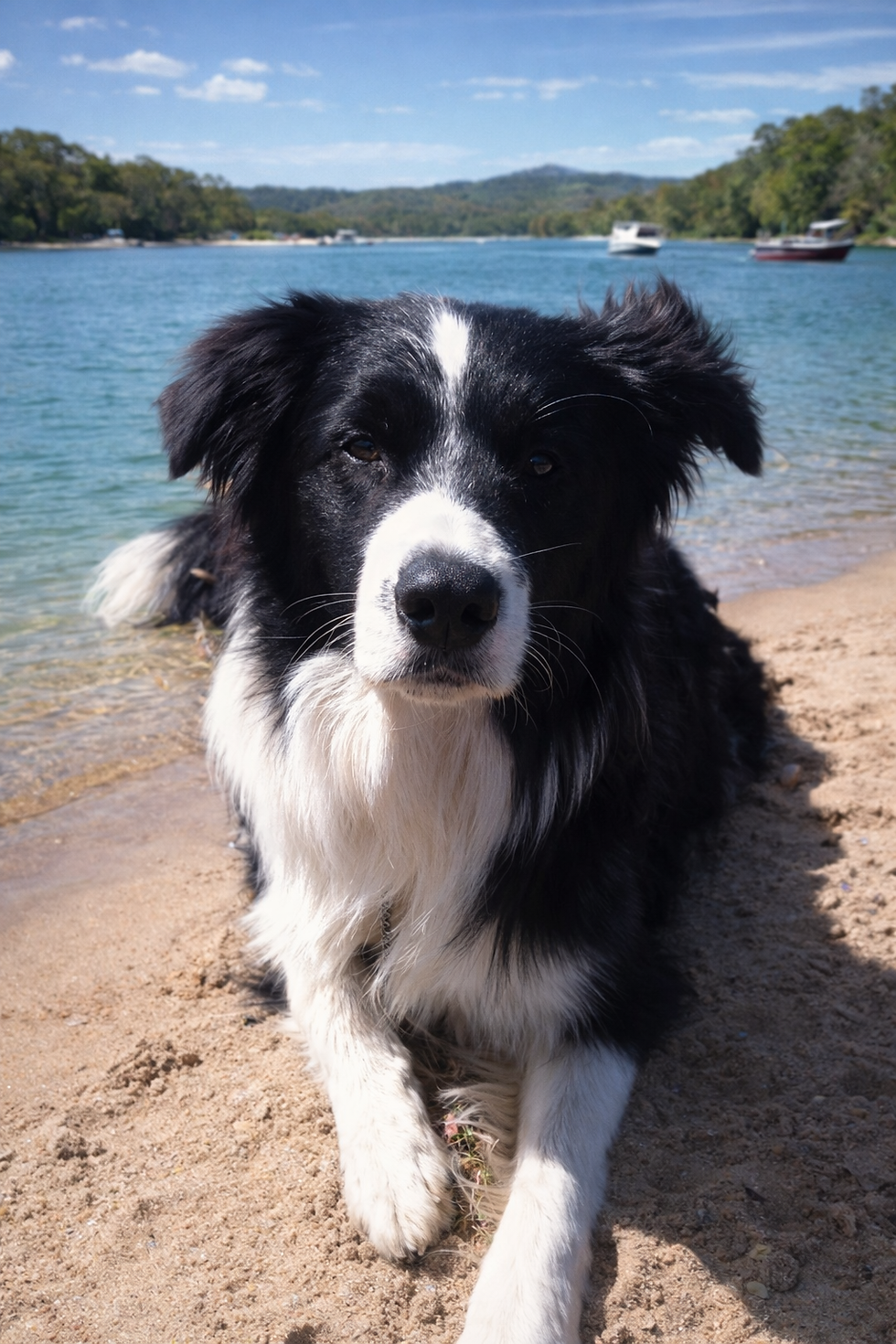
Zoe: Anticipatory Grief and a Gentle Goodbye
We brought Shadow into our lives to help Zoe grieve after Chase. Shadow was an adorable fluff-ball puppy who helped Zoe eat again, play again, and find joy again. While I loved Shadow deeply, my heart was still broken — all I wanted was my boy back.
Over the next decade, Zoe and Shadow became incredibly bonded.
As Zoe aged and her cognitive decline began, that bond shifted. Shadow naturally gravitated more towards Phoenix and Duke. It hurt to watch, but I understood — it was Shadow’s way of protecting herself.
In many ways, I was preparing myself too.
I cherished every moment with my four beautiful Border Collies. Zoe came everywhere she wanted to — even if it meant riding in her pram. She swam. She played her favourite recall game. She came to the river for BBQs and watched the world go by.
I read books on pet loss. I cried while she was still here.
This is anticipatory grief — grieving before the loss occurs.
We talked about the end. Home or vet. Comfort. Calm. Minimising stress for Phoenix, Shadow, and Duke.
On the day, Zoe told us she was ready.
My brother drove up from Brisbane for a special goodbye. Mum, Dad and I held her at the vet as she slipped away peacefully, knowing she was deeply loved.
When we came home, Duke searched for her.
The house was silent — except for our sobbing.

How Grief Affects Other Dogs
Dogs grieve too.
Research has shown that dogs who lose a companion often experience:
• Reduced appetite
• Lethargy and depression
• Increased anxiety or clinginess
• Searching behaviours
• Changes in sleep patterns
A 2016 study published in Animals found that dogs displayed clear behavioural changes after the loss of a companion dog, particularly when the bond was strong.
Phoenix became deeply depressed. He stopped eating and lost 3kg in two weeks. Duke searched for Zoe constantly. Shadow, dealing with her own knee issues, seemed emotionally stable — but grief does not always look the same.
Just like us, dogs feel the absence.
Why Losing a Dog Hurts So Much
Studies in human–animal relationships show that grief following the loss of a dog can be equal to — or even greater than — the loss of a human loved one.
Research from Archer (1997) and later Packman et al. (2011) highlights that:
• Dogs provide unconditional love and non-judgmental companionship
• They are deeply embedded in daily routines
• Their loss often comes without societal validation
This is known as disenfranchised grief — grief that is not always recognised or supported by others.
Helpful Books on Dog Loss
If you are navigating this pain, these books may help:
• “The Loss of a Pet” – Wallace Life
• “Goodbye, Friend” – Gary Kowalski
• “Dog Heaven” – Cynthia Rylant (for adults and children)
• “Being There for a Pet Who Is Dying” – International Association for Animal Hospice and Palliative Care
One Day at a Time
It has been six weeks since we lost Zoe.
I still listen for her at night, we still avoid turning on the hose, her favourite water bowl is still a trigger.
Christmas was exceptionally hard. Work was exhausting.
But we are getting there — one day at a time.

As I prepare to go back to work next week, it brings with it yet another adjustment — not just for me, but for Phoenix, Shadow and Duke. Our routines will change again, and it will mark the beginning of our first year without Zoe in our lives. That reality still feels heavy.
Grief doesn’t have an end date. It shifts, it softens, and it resurfaces in different ways as life moves forward. We are still learning how to navigate this new normal together — one day at a time.
The pain of losing a dog is real. But for me, not having dogs at all would be an even greater loss. I can’t imagine life without them. Dogs aren’t just dogs — they are the family we choose.
Kelly, Chase, Zoe three very different experiences of grief, each leaving an imprint on my heart forever. 💙🐾
If you are grieving, please know: you are not weak, dramatic, or “overreacting. ”You loved deeply — and that is something to be proud of.
At Chasing Perfection Dog Training, we honour that bond — in life, and in loss. 💙🐾


Comments